 Physics at Virginia
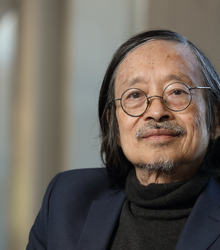
P.Q. Hung
Ph.D., 1978, UCLA
Professor Emeritus
Theoretical High Energy Physics
Research Interests
Elementary particle physics has been crowned with spectacular successes in this last quarter of the past century. The cornerstone of such a success is the Standard Model of Elementary Particles which has been tested to a high level of precision. The Standard Model (SM), however, is incomplete. It cannot predict the number of "families". (Experimentally, one knows that there at least three families.) It cannot predict the electroweak mixing angle which is measured to a high level of accuracy. One does not know the origin of the masses of the constituents of matter: the quarks and the leptons. Moreover, the SM cannot accommodate a mass for the neutrinos: a feature which is strongly suggested by recent experiments on neutrino oscillations. To answer some of these questions, there is a need to go beyond the Standard Model (and possibly search for some form of unification). What this Physics Beyond the Standard Model (BSM) might be has become one of the most active areas of research in Particle Physics. In particular, will experiments performed at the Large Hadron Collider (LHC) be able to detect new particles and/or new interactions beyond the "Higgs boson" discovered in 2012? After all, the fact that neutrinos have masses does indicate the possible existence of BSM physics. What could it be? What is the origin of neutrino masses? A very attractive mechanism that might explain why neutrinos are so much lighter than any known elementary particle (even the electron) is to postulate the existence of right-handed neutrinos and through a so-called seesaw mechannism, one obtains (mostly left-handed) neutrinos with a tiny mass consistent with experimental and cosmological bounds, and (mostly right-handed) heavy neutrinos which are yet to be discovered experimenntally.
I have constructed a model of neutrino masses with several theoretical and experimental implications. 1) Right-handed neutrinos which can interact with the weak bosons W and Z and which have masses not-too-different from the weak boson masses. They can be searched for at the LHC by looking at signals with two charged leptons with the same sign at distances far away from the beam collision point. They (and other "mirror" particles of the model) are classified as Long-Lived Paricles (LLP). There are now many proposals aiming at possible discoveries of such LLPs. 2) The model contains a non-perturbative solution which gives rise to the existence of a magnetic monopole with a mass 20-30 times the mass of the weak bosons. There is a dedicated experiment at the LHC searching for such a magnetic monopole. The name of that experimental collaboration is MoEDAL and of which I am a member. Furthermore, with two theorists from CERN and from King's College, London (John Ellis and Nick Mavromatos), we have made a successful prediction for the value of the Weak Mixing Angle without recourse to as-yet-unverified concepts of Grand Unified Theories. UVA is a member of the MoEDAL collaboration and I am the leader of the UVA group. The website of the CERN MoEDAL colllaboration is
https://moedal.web.cern.ch/collaboration
There are several theoretical (and experimental) aspects of such magnetic monopoles which remain to be explored. A detailed study of possible signatures of LLPs is also underway.
Selected Publications
P.Q.Hung,
``Topologically stable, finite-energy electroweak-scale monopoles,''
[arXiv:2003.02794 [hep-ph]]. Nuclear Physics B 962 (2021)115278
J.~Ellis, P.~Q.~Hung and N.~Mavromatos,
``An Electroweak Monopole, Dirac Quantization and the Weak Mixing Angle,''
[arXiv:2008.00464 [hep-ph]].
P.~Q.~Hung,
``The Lifetime Frontier: Search for New Physics with Long-Lived Particles,''
[arXiv:1905.09918 [hep-ph]]. Proceedings, 54rd Rencontres de Moriond on Electroweak Interactions and Unified Theories (Moriond EW 2019)
News Items
Honors
For his important contribution to the advances of Science and Education in Vietnam