 Physics at Virginia
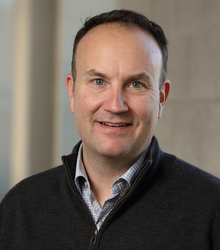
Chris Neu
Ph.D., 2003, Ohio State
Professor
Director of Graduate Studies
Experimental High Energy Physics
Research Interests
Prof. Neu's research program focuses on the building blocks of the Universe and how those building blocks interact. He studies exotic forms of matter produced at the Large Hadron Collider (LHC) at CERN as a collaborator on the Compact Muon Solenoid (CMS) experiment.
His specific interests focus on the characterization of the Higgs boson. The recent discovery of the Higgs boson has solved a significant open question in modern physics: How do the fundamental particles obtain mass? The discovery of the Higgs boson provided direct evidence for the best theory for the origin of mass -- and this advancement won Peter Higgs and Francois Englert the Nobel Prize in Physics in 2013.
However, Higgs-like bosons are predicted in many new theories of the fundamental interactions. Detailed characterization of the Higgs boson we are producing at the LHC and observing with the CMS experiment is essential for putting this new particle in context: Does this Higgs boson fit well with our current understanding of the dynamics of the fundamental world -- or is it an indicator of some new, never-before-seen interactions? Such "new physics" would shape the way we understand our Universe in the years to come.
Prof. Neu is also interested in searches for yet-unseen fundamental particles -- the existence of which could help answer some other big questions in modern science:
- What is dark matter?
- Why is gravity so feeble compared to the other forces?
- Are there any new forces beyond the ones we are familiar with?
- Why is there so much more normal matter in our Universe rather than anti-matter?
Prof. Neu's research pursues these exciting questions and more. His involvement at CMS has focused on the intersection of Higgs physics, top quark studies, other SM measurements and searches for new phenomena.
On CMS, Prof. Neu contributes to the construction, maintenance and operation of the Minimum Ionizing Particle (MIP) Timing Detector, or MTD for short. This new subsystem for the CMS experiment is a thin layer of sensitive detectors designed to measure the time of arrival of particles created in the LHC collisions with a precision of 30 pico-seconds -- or 30 trillionths of a second. This capability will allow experimenters at CMS to disentangle up to 200 nearly-coincident proton-proton collisions provided in every LHC beam crossing. The MTD will be deployed in CMS for use in the High-Luminosity era running of the LHC (HL-LHC) and will take its first collision data in 2028.
Neu serves as the Project Manager for the MTD for the US Department of Energy High Energy Physics (DOE-HEP), one of the primary funding agencies supporting the creation of this new detector. He also serves as the Primary Investigator and site leader for UVA's role as one of three global MTD Assembly Centers (along with Caltech and Milano-Biccoca), leading the local effort in Charlottesville that will build and qualify one-third of the modules used in the barrel portion of the MTD.
Group members get the opportunity to spend time resident at CERN, to contribute to the operations of the CMS experiment, to play major roles in the MTD upgrade project and to analyze CMS data as they pursue their individual research projects.
Honors and Awards:
2020: Fermilab LHC Physics Center, Guest and Visitors program
2016: University of Virginia Learning Technology Incubator Grant
2014: University of Virginia Cory Family Teaching Award
2011: University of Virginia, Vice President for Research Fund for Excellence in Science and Technology (FEST) Award
2011: University of Virginia, University Teaching Fellow
2010: University of Virginia, Mead Honored Faculty
Selected Publications
"A MIP Timing Detector for the CMS Phase-2 Upgrade", D. Contardo, et al. [CMS Collaboration] CERN-LHCC-2019-003; CMS-TDR-020.
"Technical Proposal for a MIP Timing Detector in the CMS Experiment Phase 2 Upgrade", D. Contardo, et al. [CMS Collaboration] CERN-LHCC-2017-027; LHCC-P-009.
"Observation of ttH production", A.M. Sirunyan, et al. [CMS Collaboration] Phys. Rev. Lett. 120, 231801 (2018) [arXiv:1804.02610 [hep-ex]].
"Search for ttH production in the H ! bb decay channel with leptonic tt decays in proton-proton collisions at 13 TeV", A.M. Sirunyan, et al. [CMS Collaboration] Jour. HEP. 03, 026 (2019) [arXiv:1804.03682 [hep-ex]].
"Search for black holes and sphalerons in high-multiplicity final states in proton-proton collisions at root(s) = 13 TeV", A.M. Sirunyan, et al. [CMS Collaboration] Jour. HEP. 11, 042 (2018) [arXiv:1805.06013 [hep-ex]].
"Search for the associated production of the Higgs boson with a top-quark pair", S.Chatrchyan, et al. [CMS Collaboration] Jour.HEP.09,87(2014) [arXiv:1408.1682 [hep-ex]].
"Search for the standard model Higgs boson produced in association with a top-quark pair in pp collisions at the LHC", S.Chatrchyan, et al. [CMS Collaboration] Jour.HEP.05,145 (2013) [arXiv:1303.0763 [hep-ex]].
"First measurement of the cross section for top-quark pair production in proton-proton collisions at center-of-mass energy $\sqrt{s}$ = 7 TeV", V.Khachatryan, et al. [CMS Collaboration] Phys.Lett.B.695,424-443 (2011) [arXiv:1010.5994 [hep-ex]].
"Measurement of the cross section for top-quark pair production in the semileptonic channel in proton-proton collisions at center-of-mass energy $\sqrt{s}$ = 7 TeV", V.Khachatryan, et al. [CMS Collaboration] Eur.Phys.J.C.71, 1721 (2011) [arXiv:1106.0902 [hep-ex]].
"Measurements of the production, decay and properties of the top quark: A review", K.Lannon, F.Margaroli and C.Neu., Eur.Phys.J.C.72,2120 (2012) [arXiv:1201.5873 [hep-ex]].
"First measurement of the b-jet cross section in events with a W boson in p-pbar collisions at root(s) = 1.96 TeV", T.Aaltonen,et al. [CDF Collaboration] Phys.Rev.Lett.104, 131801 (2010) [arXiv:0909.1505 [hep-ex]].
News Items
Departmental Committees
Graduate Program Committee (Chair)
Graduate Student Admissions Committee (Ex-Officio)
Financial Aid Committee (Chair)
Community Building Committee (Member)
Ph.D. Qualifying Examination Committee (Ex-Officio)
Physics Community and Outreach Committee (Ex-Officio)
Careers in Physics Seminar Committee (Member)