 Physics at Virginia
Overview
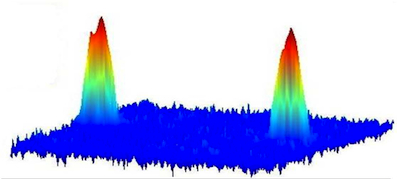
Approximately 10,000 atoms in a Bose-Einstein condensate that has been split into two packets separated by about 0.5 mm. Each atom is simultaneously in each packet.
Atomic, Molecular, and Optical (AMO) physics focuses on the fundamental quantum nature of atoms, molecules, and light, and the control of their properties and behavior for a wide variety of applications. These include atomic and molecular spectroscopy and state control, precision measurements, quantum simulation and quantum computation. Light itself is a unifying theme across much of AMO physics, since lasers of various types can be used as tools to study and manipulate atoms and molecules. Conversely, properly designed or controlled atomic and molecular samples can be used to generate light with novel properties.
UVA faculty lead AMO research projects that span the major current areas of interest in the field, including ultracold atoms, quantum optics, quantum measurement, quantum computation and simulation, quantum control, and attosecond science. The research specializations of individual faculty members are briefly summarized below.
Jones’ studies quantum control and coherent manipulation of atoms, molecules, and nano-structures. Members of his group use strong and extremely brief laser and electric field pulses to initiate, probe, and control the motion of electrons and nuclei in a variety of different systems and contexts. Of particular interest are correlation driven processes such as attosecond electronic charge migration within molecules, and the coupled dynamics of highly excited Rydberg electrons residing on distant atoms in a cold, diffuse gas.
Pfister’s research currently focuses on building a quantum computer with light and on quantum simulation using quantum optics. On the experimental side, the Pfister group, “Quantum Fields and Quantum Information” (QFQI), has been a trailblazer for implementing measurement-based quantum computing using quantum optics, in particular in the quantum optical frequency comb. Research is done in close collaboration with the photonics groups of Xu Yi, Andreas Beling, and Joe Campbell in the ECE Department at UVA. On the theoretical side, an active collaboration led by Jefferson Laboratory and including the College of William and Mary and Old Dominion University explores the quantum simulation of particle physics and, in particular, proton physics, using QFQI’s experimental quantum optics. QFQI also collaborates with the Klich group at UVA to explore the quantum simulation of quantum matter. Finally, QFQI is also involved in a number of international collaborations (Israel, France, Australia, Brazil, China), both experimental and theoretical.
Sackett’s research aims to use atom interferometry to develop new types of sensors for both scientific and practical applications. In an atom interferometer, the wave function of an individual atom is split and traverses two distinct paths, before being recombined in a phase sensitive way. The resulting signal is sensitive to a wide variety of effects. The measurements used trapped ultracold atoms in the form of a Bose-Einstein condensate. Currently Sackett’s group is investigating a loop-shaped interferometer for rotation sensing, and a linear interferometer used to probe the interactions between atoms and light. In addition, Sackett participates in a NASA collaboration to implement atom interferometry in the Cold Atom Laboratory apparatus onboard the International Space Station.
Stevenson’s research focuses on advancing our understanding of quantum physics with ultracold polar molecules. Electric dipole-dipole interactions between molecules can be used manipulate the collisional potential or to entangle pairs of molecules. Stevenson’s lab pursues both research directions with rubidium-silver molecules and seeks to build quantum simulators and quantum computers with the molecules.
Personnel
 Gordon D Cates, Jr.
Professor Cates conducts research in three diverse areas spanning atomic, nuclear, and medical physics. Unifying these activities is the use of optical pumping and spin exchange, techniques that make it possible to polarize the spins of electrons, atoms and nuclei using light sources such as lasers. Critical to such research is the study of spin interactions during atomic collisions, spin-relaxation at surfaces, and numerous aspects of laser physics. More>
 Robert R. Jones, Jr.
Much of the current research in atomic physics focuses on the use of extremely well-controlled electromagnetic fields to coherently manipulate the internal and external degrees of freedom of atoms. Jones and his students use lasers to cool and trap atoms, to spin molecules in order to align their axes along a particular direction in the laboratory, and to drive electrons within atoms and molecules in particular directions at specific times. These optical techniques serve as tools which allow them to view very fast processes within atoms and molecules and to perform experiments exploring ... More>
 Olivier Pfister
Olivier Pfister’s research focuses on experimental quantum optics and quantum information. The quantum nature of light (the existence of photons) is a fascinating subject which has turned into a mature experimental field since its inception in the eighties. The research by Pfister’s group, “Quantum Fields and Quantum Information” (QFQI), aims at blazing new trails into the realm of quantum information. In particular, QFQI and their theory collaborators, Nicolas Menicucci and Steven Flammia at the University of Sydney, discovered a new, highly scalable experimental ... More>
 Charles Sackett
Since its first observation in 1995, the process of Bose-Einstein condensation of atomic gases has captured the imagination of many physicists. In this phenomenon, a large number of atoms come to occupy the same quantum state, causing the normally ethereal wave function to act rather as a classical, observable wave. Our research is focused on developing practical applications for these condensates. In particular, we are developing condensate interferometry, in which the atom wave is coherently separated into pieces which are later recombined. The result of the recombination depends ... More>
 Ian Stevenson
My research focuses on advancing our understanding of quantum physics with ultracold polar molecules. ... More>